In fifteen years of supplying botanical ingredients, I have found that the question buyers ask me most often about hibiscus is not about health benefits at all. It is about price: why did the quotation move since last quarter, and why is one supplier quoting far less than another for what looks like the same powder?
Both questions have factual answers. Bulk hibiscus powder pricing is not set by negotiation tactics; it is set by six variables that you can identify in any quotation. Below I walk through what they are, where published trade benchmarks sat in 2026, and how to compare quotes that were priced against different specifications. I am not quoting a price here - a real price depends on your specification, volume and trade terms - but you should finish this article able to see which lever is moving.

First, Be Precise About What You Are Buying
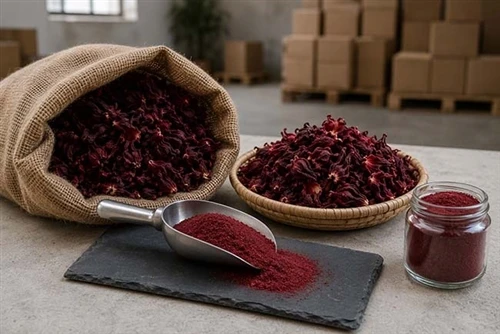
Commercial hibiscus is the dried fleshy calyx of Hibiscus sabdariffa - called zobo in Nigeria, bissap in Senegal and karkade in Sudan and Egypt. It is not the petal, the leaf or the seed. The deep red colour comes from anthocyanins, chiefly delphinidin-3-glucoside and cyanidin-3-glucoside, which are also the compounds responsible for the flavour and the functional positioning of the ingredient. Colour is therefore not decorative: it is a proxy for anthocyanin density, which is why pale or brownish material is rejected by European buyers even when its paperwork is in order.
One physical fact explains a great deal about pricing. Drying runs at roughly 10:1 - ten kilograms of fresh calyx yield about one kilogram of dried product. Everything that raises the cost of careful drying and moisture control has to be paid for inside that single kilogram.
Three product forms, three cost bases
The same crop leaves the origin as any of three commercially distinct grades, and published FOB benchmarks in 2026 spread across them by a factor of four or more:
| Form | What it is | Typical moisture | Indicative FOB range |
|---|---|---|---|
| Whole dried calyx | Hand-separated, dried, sorted calyces; the trading standard | Below 12%; premium below 10% | USD 1.40–5.00 / kg by grade |
| Cut and sifted (TBC) | 0.5–5 mm cut for tea bag and infusion blending | Below 12% | USD 2.00–5.00 / kg |
| Powder | Milled to 80–200 mesh for supplements, beverage and cosmetics | Below 8% | USD 4.00–9.00 / kg |
Those ranges are the indicative FOB benchmarks published in the March 2026 ExportReady Africa hibiscus market guide. The pattern they show is not arbitrary: powder costs more than the whole calyx it was made from, because milling adds yield loss, a tight particle-size specification, and a lower moisture ceiling that the material has to hit before it can be milled at all.

The Six Variables That Set the 2026 Price
1. Origin and the crop year
Origins are not interchangeable, and buyers price them differently. Sudan's Kordofan and Nubian calyces are consistently rated by European buyers as the best for flavour and colour, and Sudan is normally the world's largest exporter of dried calyces, with estimated annual export volumes of 50,000–80,000 MT. Nigeria - growing in Jigawa, Kano, Kaduna, Kebbi and Zamfara - is Africa's fastest-growing volume origin, estimated at 10,000–30,000 MT per year, with correspondingly wider lot-to-lot variation. Egypt, at an estimated 5,000–15,000 MT, is the origin best set up for organic certification. China and Thailand dominate global volume, and their supply is the main thing capping price upside.
Hibiscus is photoperiodic: it blooms as days shorten, which puts the West African harvest in the October to January window. Fresh volume peaks between November and February, and that is when the best buying conditions usually appear. Material bought in July is stored material, and storage costs money - yours or your supplier's.
2. Grade: colour, moisture and foreign matter
Within one origin, grade is where most of the price spread lives. The recurring specifications are colour intensity and uniformity, moisture below 12% (premium buyers often specify below 10%), foreign matter such as stems, seeds and sand, purity above 95% whole calyces, and ash value at or below 18%. Premium colourant and supplement buyers add a measured anthocyanin figure. Moisture is the quality variable with the largest commercial consequence, because under-dried material grows mould and Bacillus cereus in transit.
3. Processing: what turns a calyx into powder
Milling is a yield event, not a formality. Fine mesh grades lose more material to dust and rejects, and each mesh increment reduces the fraction that passes specification. Powder also has to be dried further - below 8% rather than below 12% - which means an extra drying pass and more energy per kilogram. Many suppliers also apply a steam treatment to reduce microbial load; European buyers generally prefer steam to irradiation or chemical treatment, but it is a processing step that must be paid for. Third-party decortication, colour sorting and metal detection all sit in the same bucket.
4. Certification: the organic step-up
Organic certification under EU Regulation 2018/848 typically commands a 15–40% price premium, and for premium supplement, retail and clean-label buyers it is not a premium at all - it is a condition of being quoted. Certification also changes the eligible supplier pool, because land conversion records, annual inspections and chain-of-custody documentation take years to build. Kosher and halal certification matters for supplement and confectionery channels, and a COA from an ISO 17025-accredited laboratory, a pesticide screen against EU maximum residue levels and heavy-metal data are baseline expectations in Europe and North America rather than extras.
5. Supply risk, logistics and trade terms
Trade intelligence platforms rate this commodity's exposure to geopolitical and supply disruption as high, precisely because global sourcing has concentrated on a limited set of corridors: conflict, border closures and port delays in parts of Northeast Africa and the Sahel can remove export availability quickly. Food-safety risk is rated equally high, and quality variability and logistics medium.
The published transaction data illustrate how much lot size and destination shape the number. Tridge's market overview for conventional dried hibiscus flower recorded 2026-03 unit prices of USD 7.44/kg for India on a 300 kg lot, USD 4.69/kg for Peru, and USD 1.04/kg for the United Arab Emirates on a 47,650 kg shipment. Nigerian monthly unit prices ran at USD 1.70/kg in October 2025 on roughly 1,001 t, USD 2.07/kg in November on 1,128 t, USD 1.62/kg in December on 556 t and USD 1.42/kg in January 2026 on a much smaller 24 t volume. Small, specialty, retail-packed or re-exported lots almost always price higher than container-scale direct shipments.
Then there is the layer buyers often negotiate last and regret: Incoterms. FOB, CIF and DDP allocate freight, insurance and destination risk differently, and moisture ingress during a long sea voyage is a real risk for a dried botanical. Poly-lined bags, desiccants and dry-container loading are cost items that show up somewhere in the quotation - as a line item, or as a rejection later.
6. Demand mix: who is buying your lot
The buyer segment determines how much of the quality curve is worth paying for. Herbal tea blenders are the largest volume segment and the most price-sensitive; they buy whole calyx in 25 kg bags, with Germany the largest single-country import market, and they compete on moisture and colour consistency. Food colourant and beverage buyers will pay more for high anthocyanin density and low foreign matter. Supplement and cosmetic formulators are the smallest segment by volume and the highest by price, and they are the ones paying for organic certification and full documentation. Category demand is still expanding - the hibiscus flower powder segment has been projected to grow at roughly 7.2% a year through 2027 - which supports grade premiums but does not lift commodity-grade prices on its own.

What Every Hibiscus Quotation Should Disclose
Two hibiscus quotes are only comparable when they cover the same list. In our own quotations we expect to state: origin and crop year; form and mesh size; moisture; ash; foreign matter and purity; anthocyanin content where relevant; microbiology including Salmonella absence in 25 g; heavy metals; pesticide screen; certification status with certificate numbers; packaging; Incoterm; volume; lead time; payment terms; and lot traceability from farm to export.
Why the Cheapest Quote Is Rarely the Lowest Landed Cost
A failed lot is the most expensive thing in this trade. A microbiological or pesticide finding at the border can mean recall of product already in the supply chain, destruction or re-export at the exporter's cost, and - in the worst case - enhanced inspection requirements for the whole origin. That asymmetry is why I advise buyers to compare suppliers on cost per kilogram of usable colour rather than cost per kilogram of powder: a cheaper lot with pale colour, higher foreign matter and 2% more moisture can cost more per unit of finished product once blending losses and rework are counted.
Practical mitigation is not complicated. Ask for pre-shipment microbiology and pesticide results, not only a historical COA. Ask for a retain sample of the exact lot. Specify moisture and mesh in writing. And pay attention to whether a supplier will name its processing facility - a trader who cannot usually cannot control your risk either.
Frequently Asked Questions
Why did hibiscus prices move so much in 2026?
Three things at once: crop quality and volume in the main African origins, concentrated supply risk in the Northeast African and Sahel corridors, and a demand mix that keeps shifting toward certified and higher-grade material. Published unit prices for Nigerian material moved from USD 1.70/kg in October 2025 to USD 2.07/kg in November and back to USD 1.42/kg by January 2026, partly because average lot sizes changed with the harvest cycle.
Is organic hibiscus powder worth the premium?
It is worth the premium if your buyers require it. Certified organic material typically carries a 15–40% price premium, and it unlocks supplement, natural-retail and clean-label channels that will not source conventional product at all. If your market does not require certification, spending the same money on tighter grading and microbiology usually delivers more finished-product value.
Why does hibiscus powder cost more per kilogram than whole calyx?
Because powder is a manufactured grade, not a form of the raw material. It carries milling yield loss, an 80–200 mesh specification, a tighter moisture ceiling (below 8% rather than below 12%), and additional handling. Indicative 2026 benchmarks put bulk whole calyx at USD 1.40–2.00/kg in standard grades and powder at USD 4.00–9.00/kg.
When is the best time of year to buy hibiscus?
The West African harvest runs from October to January, with fresh volume peaking between November and February. Contracting during or just after the harvest, with delivery scheduled later, usually gives better terms than buying stored material in mid-year - provided you specify storage conditions and confirm the crop year on the COA.
References
ExportReady Africa. Hibiscus Flower Export Market - West Africa Supply, Prices and EU Buyer Requirements. Updated March 2026. Source of the FOB grade benchmarks, moisture, ash, purity and certification figures cited above.
Tridge. Conventional Dried Hibiscus Flower - Suppliers, Trade & Prices, Market Overview 2026. Page data updated 27 September 2026. Source of country-level unit prices, transaction volumes and risk ratings.
Tridge. Dried Hibiscus Petals - Suppliers, Trade & Prices, Market Overview 2026. Source of separate petal-grade price data.
U.S. Food and Drug Administration. Import Alerts (Detention Without Physical Examination). Destination-market enforcement framework is referenced for residue and microbiological failures.
Betonnutrition is a botanical extract and ingredient manufacturer based in Xi'an, China, with more than 15 years of experience supplying standardized herbal ingredients to food, beverage, supplement and cosmetics brands in over 50 countries. We supply hibiscus powder and hibiscus extract grades built to buyer specification, with batch-level COA documentation, mesh and moisture control, and support on origin selection, certification and destination-market compliance. For a specification sheet, sample or quotation based on your own grade, email dh@betonnutrition.com or message us on WhatsApp at +86 187 9288 0979.