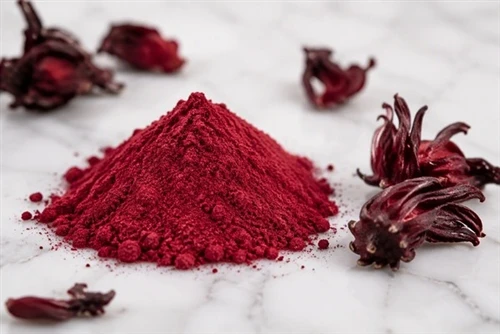
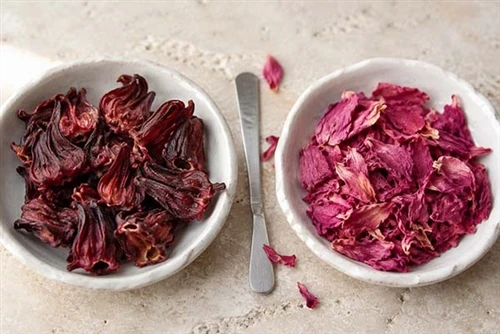
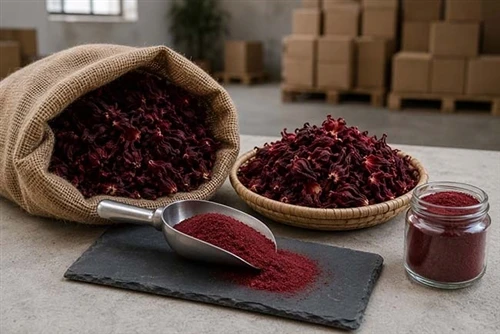
After fifteen years in plant extracts, I've learned that the most expensive mistake a buyer can make isn't overpaying for raw material. It's paying for a number that doesn't mean what you think it means. When a supplier quotes you hibiscus powder at "10% anthocyanins," what exactly are you buying? The method of analysis matters more than the percentage itself, and in this article, I'll explain why.
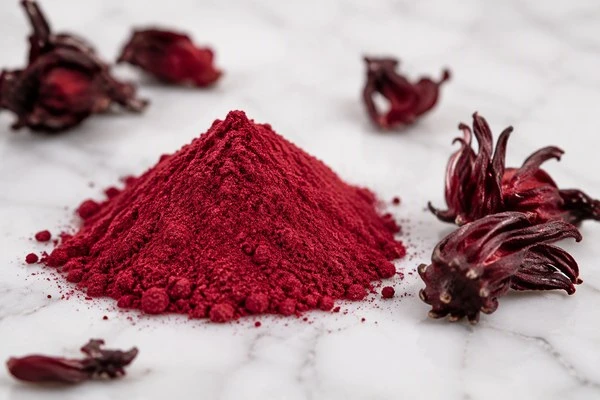
The Three Numbers Buyers Conflate
Most buyers assume that "10% anthocyanins" is a single, unambiguous measurement. In reality, there are at least three different ways to express anthocyanin content, and they are not interchangeable:
1. pH Differential (AOAC 2005.02)
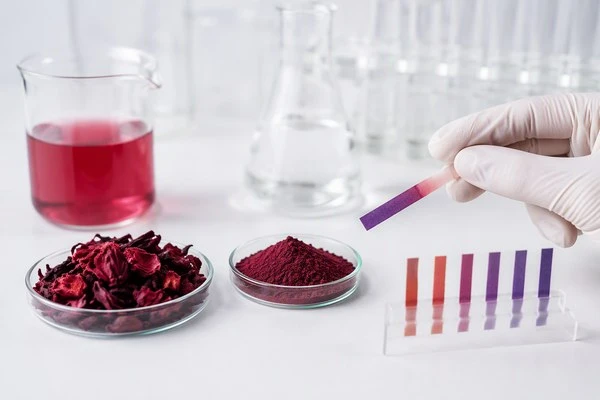
This is the most common method for total monomeric anthocyanin content. The sample is measured at two pH values: pH 1.0, where anthocyanins exist in their colored oxonium form, and pH 4.5, where they convert to colorless hemiketals. The absorbance difference at 520 nm gives the total monomeric anthocyanin content, expressed as cyanidin-3-glucoside equivalents.
Key parameters from the AOAC 2005.02 method:
Buffer pH 1.0: 0.025 M KCl (~6.3 mL HCl per liter)
Buffer pH 4.5: 0.4 M sodium acetate (~20 mL HCl per liter)
Molar extinction coefficient (ε): 26,900 L·cm⁻¹·mol⁻¹
Molecular weight: 449.2 g/mol (cyanidin-3-glucoside)
Working range: 20–3,000 mg/L
Repeatability RSD: 1.06–4.16%
Reproducibility RSD: 2.69–10.12%
The critical limitation: this method only measures monomeric anthocyanins. Polymeric or degraded pigments absorb at both pH values and are effectively invisible to this assay. A sample with high polymeric content can read deceptively low on pH differential while still showing color.
2. HPLC Individual Glycosides
High-performance liquid chromatography separates and quantifies individual anthocyanin species. For Hibiscus sabdariffa, the four major anthocyanins are:
Delphinidin-3-O-sambubioside (Dp-samb, dominant)
Cyanidin-3-O-sambubioside (Cy-samb)
Cyanidin-3-glucoside
Delphinidin-3-glucoside
Research shows that hibiscus concentrates can reach 57–64% combined Dp-samb and Cy-samb content. However, HPLC gives you the sum of individual glycosides, which is a different number from pH differential total monomeric anthocyanin. They correlate but are not identical.
3. Color Value / E163
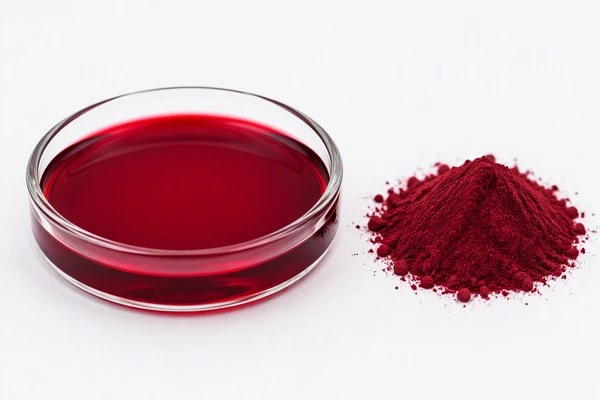
Hibiscus anthocyanin is listed as INS 163(xi), a permitted natural colorant described as "red to purple powder or liquid concentrate." Color value (often expressed as E1%, 1cm) measures color intensity rather than chemical content. A high color value doesn't guarantee high anthocyanin content if degradation products contribute to color.
Why Method Matters More Than Percentage
I've seen suppliers quote "10% anthocyanins" without specifying the method. This is like quoting a price without currency-technically a number, but practically useless for comparison.
A sample measured by HPLC (sum of individual glycosides) will typically read higher than the same sample measured by pH differential (total monomeric). If you're formulating a beverage with a target color and your supplier uses HPLC while your QC uses pH differential, you'll have a mismatch.
Stability data reinforces this concern. Studies show anthocyanin retention of approximately 91.7% at pH 2.0, dropping to 24.6% at pH 7.0. Temperature above ambient accelerates polymerization, and 121°C sterilization is destructive. Aged or heat-abused lots can have high HPLC numbers (individual glycosides still present) but collapsed pH differential values (polymerized, no longer monomeric).
Natural Variation in Raw Material
Before you even reach extraction, the starting material varies enormously:
Survey across hibiscus genotypes: 0.05–4.45% total anthocyanin
Broader commercial survey: <0.001–2.372% total anthocyanins
This 100-fold variation means that "standardized" hibiscus extract requires careful sourcing and blending. A 10% extract from high-baseline material needs less concentration than one from low-baseline material, affecting cost and process parameters.
What to Specify on Your COA
Based on fifteen years of supplier negotiations, here's what I require:
Method statement: Specify AOAC 2005.02 (pH differential) or equivalent HPLC method with column and detection parameters
Reference standard: Cyanidin-3-glucoside equivalents for pH differential; delphinidin-3-O-sambubioside for HPLC
Acceptance range: Not less than X% (NLT X%) with upper bound if color consistency matters
Stability data: Accelerated stability at 40°C/75% RH for at least 3 months
Heavy metals: Pb, As, Cd, Hg per USP/EP limits
Red Flags in Supplier Specifications
When reviewing supplier COAs, watch for these warning signs:
"Anthocyanins ≥10%" with no method cited
Color value substituted for chemical content
No reference standard specified
Stability data missing or shorter than 3 months
Heavy metals testing omitted or using outdated limits
As one industry commentator noted, "Almost every hibiscus specification says 'anthocyanins 10%'. Very few say how that number was measured." Don't be the buyer who discovers the gap after production.
Bottom Line for B2B Buyers
A percentage without a method is not a specification. When sourcing hibiscus powder or extract, demand:
Explicit analytical method (AOAC 2005.02 pH differential preferred for total monomeric)
Reference standard and extinction coefficient
Stability data relevant to your application pH and temperature
Complete heavy metals panel
The extra five minutes you spend specifying the method will save weeks of reformulation when your first batch doesn't perform as expected.
References
Lee, J., Durst, R.W., & Wrolstad, R.E. (2005). Determination of Total Monomeric Anthocyanin Pigment Content by the pH Differential Method: Collaborative Study. Journal of AOAC International. https://www.ars.usda.gov/ARSUserFiles/37108/pdf/leejaoac.pdf
ScienceDirect (2024). Stability studies of hibiscus anthocyanins. Food Bioscience. https://www.sciencedirect.com/science/article/pii/S2590157524007715
IFT Online Library (2024). Hibiscus composition survey. Journal of Food Science. https://ift.onlinelibrary.wiley.com/doi/10.1111/1750-3841.16909
IOMC World. Ethiopian roselle genotypes anthocyanin content. https://iomcworld.com
Sage Journals (2017). Anthocyanin concentrates from hibiscus. Natural Product Communications, 12(1). https://journals.sagepub.com
IACM Color. INS 163(xi) Hibiscus colour specification. https://iacmcolor.org
SV Botanica (2026). Hibiscus anthocyanin standardisation insights. https://svbotanica.com/insights/hibiscus-anthocyanin-standardisation