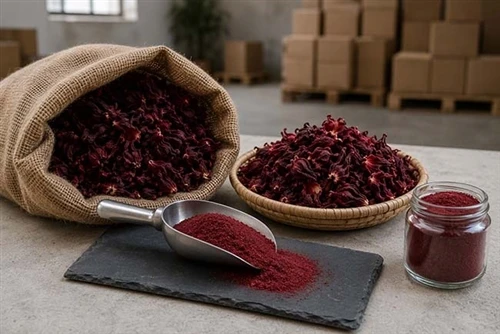
We supply plant extracts to manufacturers across supplements, food and beverage, and cosmetics - and few ingredients generate more first-quote interest, and more first-quote confusion, than hibiscus. Listings promise "100% pure" powder at prices that span a tenfold range, and the words roselle, rosella and hibiscus extract are used loosely. As a buyer, the real question is not "who has the lowest price per kilogram" but "how do I verify that this manufacturer can deliver the same material, to the same spec, batch after batch?" This guide gives you a framework to answer that before money changes hands.
Vet a bulk hibiscus sabdariffa manufacturer across five pillars - botanical identity and traceability, specifications and batch COA, certifications and regulatory fit, facility and process control, and commercial reliability. A supplier who performs on all five protects you from the three most expensive failure modes: adulterated or misidentified material, batch inconsistency discovered mid-production, and compliance blocks in your destination market.
Why Vetting Matters More Right Now
Hibiscus has moved from a niche tea botanical to a strategic ingredient. Market analyses value the global hibiscus extract market at roughly USD 130 million in 2025, growing toward USD 230 million by 2032 at about an 8% CAGR, with powder formats accounting for around 70% of demand and beverages the largest application. Two forces amplify the stakes for buyers:
The natural colorant wave. Demand for natural red shades grew about 5% in 2024 while synthetic Red 40 remains under regulatory scrutiny in several jurisdictions. Hibiscus anthocyanins are one of the few red sources stable enough for acidic, heat-processed beverages - so more products depend on this supply chain.
Raw-material volatility. Hibiscus sabdariffa supply is concentrated in a handful of origins (Sudan, China, Thailand, Egypt, Nigeria, Mexico), and price swings from weather and geopolitics push some sellers toward thinner quality controls. When input costs rise, vetting discipline is what keeps quality from eroding.
Know Your Ingredient: Calyx Powder vs. Concentrated Extract
Most sourcing mistakes start at the definition. Hibiscus powder can mean two very different products:
Whole-calyx (roselle) powder - dried edible calyces of Hibiscus sabdariffa, milled and sieved. No concentration step. Typical for tea blends, bakery and cosmetic bases.
Extract powder - concentrated (commonly 5:1 to 20:1), often spray-dried onto a carrier such as maltodextrin, and standardized to an anthocyanin content of roughly 5–15% by HPLC. This is the grade used for functional beverages, capsules and premium color applications.
The active profile centers on anthocyanins - with delphinidin-3-sambubioside and cyanidin-3-sambubioside as lead markers - plus organic acids (hibiscus acid, citric, malic, tartaric) and polyphenols such as chlorogenic acid . On the clinical side, a systematic review of randomized trials found that daily hibiscus tea lowered systolic blood pressure by around 7 mmHg in hypertensive adults over six weeks - evidence generated with tea preparations, so a formulator should not transfer that finding to a concentrated extract without its own substantiation.
The Five-Pillar Vetting Framework

Run every candidate manufacturer through these five pillars. A failure in any one of them is a finding, not a footnote.
Pillar 1 - Botanical Identity & Traceability
The specification must state the Latin name (Hibiscus sabdariffa L.), the plant part (calyx - not leaf, not an ornamental Hibiscus rosa-sinensis), the origin country and ideally the cultivar and harvest window. Ask whether the supplier mills and extracts in-house or trades from third parties; a vague "we partner with trusted farms" usually means you are buying from a reseller with less control over the chain. Traceability matters commercially too: high-anthocyanin material commands a 15–20% premium, and verifying cultivar and harvest date is exactly what justifies it.
Pillar 2 - Specifications & Batch COA
This is where most purchases are actually won or lost. A working hibiscus powder specification should include, at minimum:
| Parameter | What to require |
|---|---|
| Anthocyanin content | Lot-specific HPLC assay (5–10% supplement grade; 10–15% premium color grade) with a stated method and lead-marker ID |
| Moisture | ≤ 8–10%. Above 10% is a clumping and microbial risk in humid warehouses |
| Particle size | 80–100 mesh for tea blending; 120 mesh or finer for cosmetics and nutraceuticals - and it should be priced accordingly |
| pH / acidity | Declared organic-acid profile; drives both flavor and anthocyanin color stability |
| Heavy metals | As, Pb, Cd, Hg by ICP-MS against your target-market limits (as an illustration, tight internal controls run As ≤ 0.1, Pb ≤ 0.2, Cd ≤ 0.3, Hg ≤ 0.05 ppm) |
| Microbiology | TPC, yeast & mold, coliforms, E. coli, and Salmonella absent in 25 g |
| Pesticide residues | Screen against EU Regulation 396/2005 MRLs - cultivation practices vary widely by origin |
| Carrier disclosure | For extracts: carrier identity and level (e.g. maltodextrin 1–20%), so label and dose math work |
Two non-negotiables: the COA must be lot-specific (not a datasheet reprint), and it should come from an ISO 17025-accredited laboratory - a requirement EU buyers increasingly treat as standard. Ask for the COA before dispatch, not with the shipment.

Pillar 3 - Certifications & Regulatory Fit
Baseline manufacturing credentials: GMP, ISO 22000 or FSSC 22000, HACCP. Product-level certifications depend on your market - USDA or EU organic (Regulation 2018/848, which also requires chain-of-custody records and typically adds a 15–40% price premium), Halal and Kosher. For EU food-supplement buyers, confirm the material's legal status: Hibiscus sabdariffa calyces appear on the BELFRIT list and the German positive list of botanicals permitted in supplements. In the US, roselle appears in FDA's inventory of substances added to food for flavoring use - which supports tea and flavor applications but does not automatically authorize every concentrated extract, dosage or color use; claims substantiation remains a buyer-side exercise.
Pillar 4 - Facility, Process & Stability
Anthocyanins are unforgiving during processing, so a capable manufacturer should be able to talk credibly about them. Probe for:
Thermal discipline. Spray-drying inlet temperatures trending below 170 °C, and awareness that every thermal event - hot-fill, gummy depositing, warehouse heat - causes cumulative anthocyanin loss.
Moisture control. The organic-acid fraction makes hibiscus extract hygroscopic; expect desiccant-packed, sealed, light-protective packaging and honest guidance on RH control during filling.
Color stability guidance. A good supplier tells you up front that hibiscus shows bright red at pH 2–4.5 and shifts purplish above that range, and can support stability trials rather than just selling powder.
Finished-form testing. For gummies and beverages, ask whether they support assay of the finished product, not only the raw material.
Pillar 5 - Commercial Reliability
Quality means little without delivery. Before signing, run the five questions:
Do you mill and extract in-house, or source from third parties?
How often do you test for microbial contamination, and which laboratory performs it?
Will you send the COA before dispatch?
What is your written policy on off-spec batches? ("Case by case" means there is no policy.)
Are your certifications current, and can you share certificate numbers and issuing bodies?

Finally, evaluate on total cost-in-use, not price per kilogram: delivered ingredient cost + testing burden + required dosage + processing loss + rejection risk + storage cost. A cheaper powder that needs a higher dosage or fails a stability study is the more expensive one.
Red Flags That Should Stop a Purchase
Unclear plant identity or inconsistent plant-part terminology (calyx vs. "flower" vs. leaf)
Undisclosed carriers in "extract" powders, or extraction ratios with no calculation basis
Datasheet COAs reprinted for every lot; no ISO 17025 lab named
Refusal to send the COA before dispatch
No written off-spec or compensation policy
Certifications with lapsed validity or unverifiable certificate numbers
A color that is brownish or faded - a visual marker of degraded anthocyanins
From Sample to Scale: A Practical Vetting Workflow
Write the spec first. Agree identity, grade (whole powder vs. extract), anthocyanin range, limits and test methods - in writing - before requesting quotes.
Request samples with full documentation (spec sheet, lot COA, SDS, certifications). Serious manufacturers ship samples with the same documents that ship with production lots.
Verify independently. Send the sample to a third-party lab for anthocyanin assay, heavy metals and micro against your spec.
Run a formula trial - including any thermal steps - and check color, solubility and sediment in your actual matrix.
Contract the controls: pre-dispatch COA, written off-spec policy, retained samples, and audit rights. Then scale in steps (e.g. 25 kg trial → 100 kg launch → monthly volume) as consistency proves itself.
Frequently Asked Questions
What is the difference between hibiscus calyx powder and hibiscus extract powder?
Whole-calyx powder is dried Hibiscus sabdariffa calyces milled and sieved - typically 80–100 mesh for tea blending. Extract powder is concentrated (e.g. 5:1 to 20:1), often spray-dried with a carrier, and standardized to roughly 5–15% anthocyanins by HPLC. They are not interchangeable, and every specification should state which one it covers.
What anthocyanin content should I specify for bulk hibiscus powder?
Commercial grades typically run 5–10% for dietary supplements and 10–15% for premium natural color applications. Require a lot-specific HPLC assay against a stated method, with delphinidin-3-sambubioside identified as the lead marker - not a datasheet range.
Which certifications are non-negotiable?
Baseline: GMP plus ISO 22000/FSSC 22000 and HACCP. Market-dependent: USDA or EU organic (Regulation 2018/848), Halal, Kosher. For EU supplements, check BELFRIT and the German positive list. COAs from an ISO 17025-accredited laboratory are the professional standard.
Why did my hibiscus beverage change color?
Hibiscus anthocyanins are pH- and heat-sensitive: bright red at pH 2–4.5, shifting purplish or grey above that. Thermal steps cause cumulative loss, and vitamin C can accelerate degradation. Formulate in the acidic window, minimize heat, protect from light and oxygen, and build assay overage.
What should I ask a manufacturer before placing a bulk order?
The five questions: in-house processing vs. reselling; per-batch testing schedule and lab; COA before dispatch; written off-spec policy; and current, verifiable certifications. Their answers - or evasions - tell you most of what you need to know.
References
Da-Costa-Rocha, I. et al. "Hibiscus sabdariffa L. - A phytochemical and pharmacological review." Food Chemistry (2014). pubmed.ncbi.nlm.nih.gov/24799474
Serban, C. et al. "A systematic review and meta-analysis on the impact of Hibiscus sabdariffa on blood pressure." Nutrients (2015).
Atlas AgroFood. "Hibiscus Powder: Natural Purple-Red Colorant for Food & Beverage Manufacturers." atlasagrofood.co.in/blog/hibiscus-powder-guide
Durjaya Herbals. "A Buyer's Checklist for Sourcing Hibiscus Powder at Scale." guestpostglobal.com
SV Botanica. "Hibiscus Extract Applications & Formulation Guide." svbotanica.com
Bionutricia Extract. "Roselle Extract Powder (Hibiscus sabdariffa) - Bulk B2B Supplier." bionutriciaextract.com
PW Consulting / Pro Market Reports. "Hibiscus Extract Market Report 2025–2032." pmarketresearch.com
Export Ready Africa. "Hibiscus Flower Export Market - EU Buyer Requirements." exportready.africa
Essencefield. "Roselle Powder for B2B Buyers: Specifications, Testing and Supplier Evaluation." essencefield.com
Bio-Botanica. "Hibiscus Botanical Extract - Documentation & Testing." bio-botanica.com
Taj Henna. "Best Hibiscus Powder Manufacturer in India." tajhenna.com