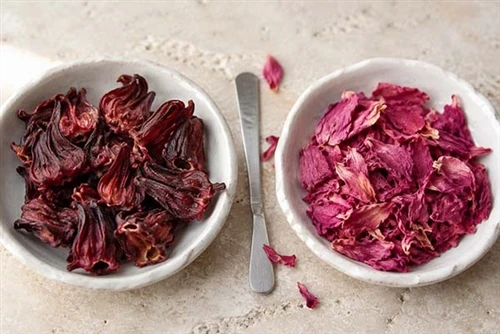
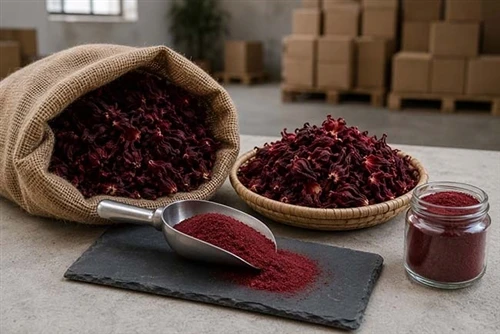
New buyers often treat hibiscus powder and hibiscus extract as the same ingredient at two concentrations. They are not. They are two different ways of expressing strength, packaged with two different labelling conventions and two different risk profiles. Choosing the wrong one rarely fails in the lab; it fails on the label, in the bottle, or in a clear beverage six weeks after launch.
Here is how I would compare them as a formulator would - on dosage, colour, cost and claims - plus the ratio trap that catches more beverage and supplement buyers than any other issue in this category.
Two Different Ways of Expressing Strength
| Hibiscus powder | Hibiscus extract | |
|---|---|---|
| What it is | Dried, milled Hibiscus sabdariffa calyx - a crude botanical | Native extract produced by solvent extraction, usually sold with a carrier |
| Strength stated as | Mesh size plus a measured marker content on the powder itself | A plant-to-extract ratio, or a standardised marker percentage |
| Extraction step | None | Solvent, concentration and often spray-drying |
| Typical carrier | None | Maltodextrin or similar, added by design and sometimes in large amounts |
| Where it usually wins | Tea and infusion blenders, botanical-appearance products, colour-stable opaque formats | Capsules, gummies, clear beverages, and any formula that needs batch-to-batch consistency |
What a ratio does and does not tell you
A ratio describes how much dried plant went in. If 100 kg of dried root yields 20 kg of extract, the ratio is 5:1 - what the European Medicines Agency calls the genuine drug-to-extract ratio, or the native extract ratio. Once an excipient is added, the resulting figure becomes the total ratio, and the two are routinely conflated. European and Australian labels often express the ratio as a range - 4–7:1 rather than a single value - because a given quantity of plant material does not reliably yield the same mass of extract. North American labels more often print a single number.
What a ratio does not tell you is how much native extract is actually in the bag. That is a separate number, and it is the one that decides your economics.
Why dilution became a label issue
US regulation at 21 CFR 101.36(b)(3)(ii)(C) states that for a dietary ingredient that is an extract with the solvent removed, the declared weight is the weight of the dried extract. A former FDA associate director has been quoted interpreting that to mean any excipient must be declared separately from the native dry extract - so fillers used to adjust the plant-to-extract ratio are not part of the labelled extract weight. Industry guidance published by the American Herbal Products Association in 2000 took a more permissive view, defining an extract as the combination of native extract plus carrier.
That gap is where the problem lives. A contract manufacturer's own worked examples, reproduced in a 2024 analysis by the Botanical Adulterants Prevention Program, show how flexible the arithmetic is:
80% of a 5:1 concentrate + 20% carrier = a 4:1 final ratio
40% of a 25:1 concentrate + 60% carrier = a 10:1 final ratio
60% of a 10:1 concentrate + 40% carrier = a 6:1 final ratio
40% of a 10:1 concentrate + 60% carrier = a 4:1 final ratio
Two documented cases make the stakes concrete. In one, a milk thistle extract sold with a stated 4:1 ratio arrived with a certificate of analysis showing 5% milk thistle extract and 95% maltodextrin; the native extract behind it was a 20-times-diluted 80:1 material, so a label line reading "180 mg milk thistle extract (4:1)" described roughly 9 mg of native extract. In another, a valerian root/rhizome extract produced a blank lane in high-performance thin-layer chromatography - no characteristic metabolites at all - and the original producer reportedly stated the material contained 0.25% valerian extract and 99.75% maltodextrin.

Dimension 1 - Dosage and Fill Weight
Powder is dosed in grams; extract is dosed in milligrams. A tea or infusion product can absorb several grams of powder per serving without difficulty, which is why blenders buy powder or cut grade. A two-piece capsule usually cannot. If your serving target is expressed in grams, powder is the only economical route; if it is expressed in hundreds of milligrams and your label cites a marker, you are buying an extract.
The critical discipline is to state your requirement as a marker amount, not as a ratio. "250 mg of hibiscus extract" is not a specification; "the equivalent of X mg of anthocyanins, measured by a named method" is. Ratios can be manufactured by dilution, marker content cannot.
Dimension 2 - Colour, Solubility and Appearance
This dimension decides itself by dosage form. Powder disperses - it does not fully dissolve - and brings the botanical appearance and some sediment with it. That is an asset in opaque beverages and a defect in clear ones, so assess sediment and clarity in your actual matrix before you commit.
Extracts give you more colour per gram with better clarity, but the numbers are less dramatic than the marketing suggests. FEMA's published composition for hibiscus blossom extract lists water above 30%, hibiscus acid at 12–18%, hydroxycitric acid at 2–7%, minerals at 5–10%, fructose and glucose at 3–5%, phenols at 1–3.5% and anthocyanins at 0.3–0.6%, with volatiles below 0.1%. A "standardised" grade is a further-purified fraction - supplier specifications in this category commonly offer extracts standardised to 5–25% anthocyanins for colour and E163 natural red applications.

Whichever format you choose, anthocyanins are the fragile part. A 2023 stability study on spray-chilled microparticles of red hibiscus anthocyanins found that storage at 35 °C together with light exposure affected anthocyanin retention over the stability period - so specify storage conditions and ask for real-time data, not just accelerated data.
Dimension 3 - Cost per Unit of Delivered Marker
Price per kilogram is meaningless across these two formats, because one is a whole plant material and the other is a concentrate plus carrier. Published trade benchmarks place hibiscus powder in the single-digit US dollars per kilogram at bulk volume (ExportReady Africa market guide, March 2026), while extract grades trade against their marker specification and carrier load rather than any commodity reference.
Normalise before you compare: cost per kilogram of native extract, then cost per unit of the marker you actually need in the finished serving. A cheap 10:1 extract that is 40% native extract and 60% maltodextrin is, per kilogram of native extract, 2.5 times its quoted price. Run that arithmetic and the "expensive" concentrated grade frequently turns out to be the cheaper way to buy colour.
Dimension 4 - Claims, Labelling and Adulteration Risk
There is a measurable difference in risk between the two formats. A laboratory review of routine test results from 2017 to 2019 covering 379 crude botanical ingredients - whole, cut or powdered plant parts - and 1,028 extracts found no crude materials lacking their expected constituents, but classified 11% of the extracts as "empty," with none of the constituents characteristic of the labelled botanical. Crude botanicals are simply harder to fake: you can see and smell the calyx.
On claims, the same discipline applies to both formats. Keep weight-loss, cancer and cure language off any hibiscus product; treat blood-pressure positioning as a claim-boundary question that depends on your market rather than a marketing asset; and note that if you intend to use hibiscus as a colourant, you are in a different regulatory conversation than if you are selling it as a botanical ingredient.
A Four-Question Decision Framework
| Your constraint | Choose | Because |
|---|---|---|
| Serving measured in grams; infusion or tea blend | Cut grade or powder | Extract economics collapse at gram doses |
| Clear or lightly coloured beverage | Standardised extract | Clarity and controlled sediment |
| Capsule or gummy with a stated colour or marker target | Standardised extract | Batch-to-batch consistency and compact dose |
| Lowest risk of substitution or empty material | Powder | Crude botanicals tested clean in the audit cited above |
| Lowest cost per gram of botanical | Powder | No extraction, concentration or carrier cost |
| Pantry-style "natural appearance" positioning | Powder | Visible botanical character is the selling point |
What to Put in the Specification
If you buy powder: plant part (calyx), species (Hibiscus sabdariffa), mesh or particle size, moisture, anthocyanin or marker content with the named method, foreign matter, microbiology, and a lot retain sample. If you buy extract: native extract ratio stated as a range, carrier identity and its percentage of the mass, marker content with the method, extraction solvent, residual solvents, microbiology, and a declaration that separates native extract from carrier. Then apply one rule to both: if the supplier cannot tell you the native extract content of an extract, you are buying a carrier blend with a botanical name.
Frequently Asked Questions
Is hibiscus extract stronger than hibiscus powder?
Per gram, usually yes - but "stronger" needs a marker to mean anything. FEMA's composition for hibiscus blossom extract lists anthocyanins at 0.3–0.6%, while standardised grades are offered at 5–25% anthocyanins. A ratio extract with a high carrier load may be weaker per gram than the ratio implies.
What does "10:1 hibiscus extract" mean?
It means that, nominally, ten mass units of dried plant material were used per mass unit of extract. It does not mean that ten grams of plant material are present in every gram of the material you receive. Published dilution examples show how a 10:1 final ratio can be reached from a 25:1 concentrate with 60% carrier, so always ask for the native extract content alongside the ratio.
Can I use hibiscus powder in a clear beverage?
You can, but expect dispersion rather than dissolution, and therefore turbidity and sediment. If visual clarity is part of the product promise, use a standardised extract and validate the colour after your process temperature, pH and hold times.
Which format is cheaper per serving?
Almost always powder, because no extraction, concentration or carrier cost is involved. The exception is a product that needs gram-level colour per serving in a small dose form - there, a standardised extract can deliver the same visual result from far less mass.
References
Gafner S, Loffredo L, Kababick J, Wise SM, Upton R. The Undisclosed Presence of Excipients and Diluents in Botanical Extracts. HerbalGram 2024;140:44-51. Botanical Adulterants Prevention Program.
Monagas M, Brendler T, Brinckmann J, et al. Understanding plant to extract ratios in botanical extracts. Frontiers in Pharmacology 2022;13:981978.
Flavor and Extract Manufacturers Association. Flavour library entry: hibiscus blossom extract - measured composition of Hibiscus sabdariffa blossom extract.
US Code of Federal Regulations. 21 CFR 101.36, Nutrition labeling of dietary supplements, including paragraph (b)(3)(ii)(C) on dried extracts.
Stability of red hibiscus anthocyanins in spray-chilled microparticles: effect of storage temperature and light exposure on anthocyanin retention. Food Research International 2023.
ExportReady Africa. Hibiscus flower export market: supply, grades and price benchmarks. March 2026 - powdered grade benchmark.
Trade supplier specification pages for standardised hibiscus flower extract (5–25% anthocyanins, E163 colour applications). Example supplier specification.