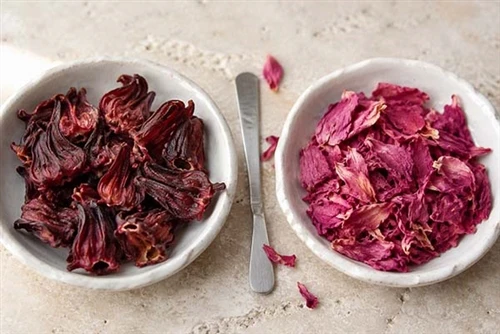
A buyer once sent me a hair-mask brief that read, in full, "hibiscus powder." When I asked which species, the reply was that it did not matter - hibiscus is hibiscus. It does matter, and in this case it mattered commercially as well as technically: the customer's formulation notes described petal extract, the name on the purchase order was the roselle calyx, and the two are not the same plant, the same part, the same chemistry or the same regulatory category.
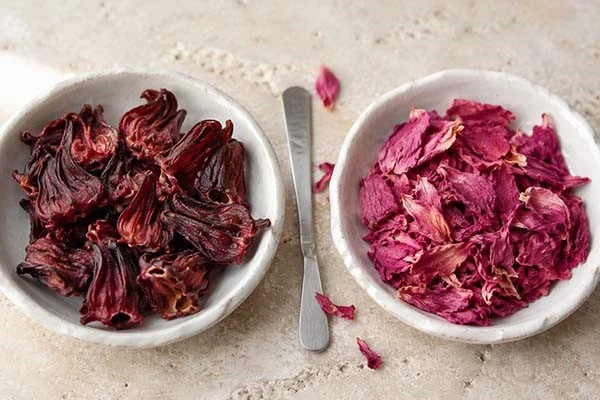
In this article I set out how Hibiscus sabdariffa and Hibiscus rosa-sinensis actually differ on the buying side of the table, where each one performs, the compliance trap that catches brands treating them as interchangeable, and how to specify and verify the species you ordered.
Two plants, one name, almost nothing else in common
| Hibiscus sabdariffa | Hibiscus rosa-sinensis | |
|---|---|---|
| Common names | Roselle, zobo (Nigeria), bissap (Senegal), karkade (Sudan, Egypt), flor de Jamaica | Chinese hibiscus, tropical hibiscus |
| Part traded | The dried fleshy calyx - the structure left after the flower falls | Flower and leaf, supplied for topical use |
| Plant type | Annual crop, warm-season, rainfed in semi-arid zones | Perennial ornamental shrub of hybrid origin |
| Colour chemistry | Anthocyanins dominated by delphinidin-3-O-sambubioside and cyanidin-3-O-sambubioside | A different flavonoid and mucilage profile; colour less anthocyanin-led |
| Harvest pattern | Single main harvest, roughly October to January in West Africa | Cut and harvested through the growing cycle |
| Primary industries | Herbal tea, beverages, natural colour, supplements, food | Hair care and skin care cosmetics |
| Regulatory home | Food and flavouring use | Cosmetic ingredient nomenclature |
Why the plant part matters more than the name
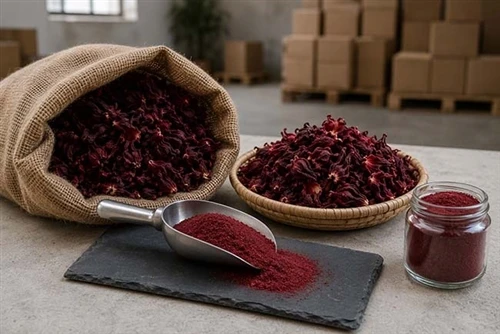
When you buy H. sabdariffa, you are buying a calyx: the swollen red structure that remains after the flower has fallen. It is harvested by hand, separated from the seed pod, dried and traded as whole calyx, cut and sifted grade, or milled powder. Drying runs at roughly ten kilograms of fresh calyx to one kilogram of dried material, which is why post-harvest handling dominates the cost and the quality of the finished lot. The main anthocyanins - delphinidin-3-O-sambubioside and cyanidin-3-O-sambubioside - are what give the material its colour, its tart flavour and most of the functional value buyers care about.
When you buy H. rosa-sinensis, the trade is different in every respect. The plant is a perennial ornamental of hybrid origin, grown for its flowers rather than for a single annual harvest, and the commercially supplied parts are the flower and the leaf. There is no calyx trade, no equivalent 10:1 drying ratio, and no anthocyanin specification to grade against. The two materials cannot be substituted for one another in colour, flavour or chemistry, and a specification that names neither the species nor the plant part is not a specification at all.
Where each species actually performs
Hibiscus sabdariffa: ingestible, beverage and colour applications
Roselle is the species behind hibiscus tea, ready-to-drink infusions, natural red colour in beverages and confectionery, and supplement formats. The human evidence base is concentrated here. A 2025 meta-analysis of 26 randomised controlled trials (N = 1,797) found that H. sabdariffa reduced systolic and diastolic blood pressure in a dose-dependent manner, with comparable efficacy to antihypertensive medication in the pooled analysis, alongside improvements in total cholesterol, LDL-C, fasting glucose and HDL-C. That is a striking finding - and it is exactly the kind of finding a brand must not put on a label. A Cochrane review of the same question concluded that the evidence remains insufficient to determine efficacy in primary hypertension. The honest commercial reading is that the ingredient is well studied for cardiovascular support, and that claims must stay within what your market's regulations allow.
There is also skin evidence worth knowing about: a 12-week, randomised, double-blind trial (N = 98) found a H. sabdariffa enzyme extract improved skin hydration, elasticity and the appearance of periorbital wrinkles. So sabdariffa is not exclusively a beverage ingredient - it can carry a topical story too.
Why the plant part matters more than the name
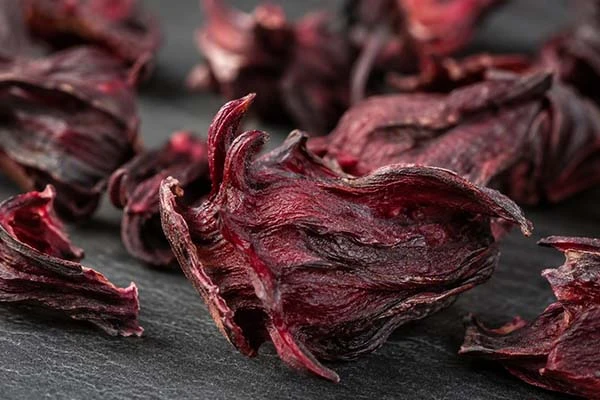
When you buy H. sabdariffa, you are buying a calyx: the swollen red structure that remains after the flower has fallen. It is harvested by hand, separated from the seed pod, dried and traded as whole calyx, cut and sifted grade, or milled powder. Drying runs at roughly ten kilograms of fresh calyx to one kilogram of dried material, which is why post-harvest handling dominates the cost and the quality of the finished lot. The main anthocyanins - delphinidin-3-O-sambubioside and cyanidin-3-O-sambubioside - are what give the material its colour, its tart flavour and most of the functional value buyers care about.
When you buy H. rosa-sinensis, the trade is different in every respect. The plant is a perennial ornamental of hybrid origin, grown for its flowers rather than for a single annual harvest, and the commercially supplied parts are the flower and the leaf. There is no calyx trade, no equivalent 10:1 drying ratio, and no anthocyanin specification to grade against. The two materials cannot be substituted for one another in colour, flavour or chemistry, and a specification that names neither the species nor the plant part is not a specification at all.
Where each species actually performs
Hibiscus sabdariffa: ingestible, beverage and colour applications
Roselle is the species behind hibiscus tea, ready-to-drink infusions, natural red colour in beverages and confectionery, and supplement formats. The human evidence base is concentrated here. A 2025 meta-analysis of 26 randomised controlled trials (N = 1,797) found that H. sabdariffa reduced systolic and diastolic blood pressure in a dose-dependent manner, with comparable efficacy to antihypertensive medication in the pooled analysis, alongside improvements in total cholesterol, LDL-C, fasting glucose and HDL-C. That is a striking finding - and it is exactly the kind of finding a brand must not put on a label. A Cochrane review of the same question concluded that the evidence remains insufficient to determine efficacy in primary hypertension. The honest commercial reading is that the ingredient is well studied for cardiovascular support, and that claims must stay within what your market's regulations allow.
There is also skin evidence worth knowing about: a 12-week, randomised, double-blind trial (N = 98) found a H. sabdariffa enzyme extract improved skin hydration, elasticity and the appearance of periorbital wrinkles. So sabdariffa is not exclusively a beverage ingredient - it can carry a topical story too.
Hibiscus rosa-sinensis: topical hair and skin care
Chinese hibiscus is a cosmetic species, and the industry treats it as one. Its ingredient nomenclature family includes flower extract, flower powder, leaf extract, leaf cell extract, flower and leaf extract, and oil - a breadth of derivative forms that reflects how established it is in personal care, particularly in hair care, where it has a long traditional use and where preclinical work has explored topical hair-growth activity (a 1% crude extract applied for 42 days in a rat model). As a marketing and formulation ingredient, it is credible in conditioners, masks, scalp serums and hair oils. As a food or supplement ingredient, it has no comparable position.
The compliance trap: a cosmetic INCI name is not a food authorisation
This is the mistake that costs brands real money. An INCI listing tells you a material is recognised for use in cosmetics. It says nothing about whether the same material may legally be eaten.
Compare the two species in one place, the US Substances Added to Food inventory, which is FDA's searchable list of food additives, GRAS substances and related entries. Searching it for "hibiscus" returns an entry for Roselle (Hibiscus sabdariffa L.), listed as a flavouring agent or adjuvant under 21 CFR 172.510. There is no H. rosa-sinensis entry. Two caveats matter here. First, the inventory is explicitly a partial list of food ingredients, so the absence of an entry is not a formal prohibition - it means there is no shortcut, and the burden of establishing lawful use sits with you. Second, labels are not approvals: NIH's Dietary Supplement Label Database records "infusion (1:6000) of hibiscus rosa-sinensis" among label terms, which documents what some manufacturers have printed, not what regulators have permitted.
In the EU, the picture is structurally similar. The roselle calyx has a long history of food use, and the flower, leaf, branch and seed of H. sabdariffa appear on the harmonised botanical lists used for food supplements in member states, with established colourant applications in food. There is no equivalent position for H. rosa-sinensis. If you are developing an ingestible SKU, decide your launch market first, then confirm the species' food status in writing for that market before you buy a kilogram of anything.
How to specify and verify the species you ordered
Four items should appear on every hibiscus specification you issue or receive: the full Latin binomial; the plant part; the standardisation basis, such as anthocyanin content where relevant; and the origin with crop year. If any of the four is missing, the document cannot protect you.
Verification then runs from cheap to conclusive. Macroscopic and microscopic identification catches obvious mismatches - petals or leaf fragments in a material specified as calyx. HPTLC fingerprinting separates species-level chemical profiles and is the workhorse of incoming botanical QC. DNA barcoding resolves identity at the species level even in dried, milled material, and it is the tool behind the industry's most uncomfortable data: barcoding surveys of traded medicinal plant raw drugs have found roughly 20% adulteration, with at least 6% of samples derived from completely different species. Keep a retain sample of every lot, and re-authenticate periodically rather than only at qualification.
The red flags are predictable: an ingredient called simply "hibiscus extract" with no binomial; a specification that says "Hibiscus spp."; a COA that names the calyx while the sample shows petals; or a supplier who cannot say which plant part they processed. Any of these means your finished product carries an identity risk that no marketing claim will offset.
Which species for which product
| Application | Species | Plant part | Reason |
|---|---|---|---|
| Herbal tea and infusion blends | H. sabdariffa | Calyx, whole or cut | The established infusion material; graded on colour and moisture |
| Ready-to-drink and beverage colour | H. sabdariffa | Calyx or calyx extract | Anthocyanin-driven red colour with a familiar flavour profile |
| Cardiovascular-positioned supplement | H. sabdariffa | Standardised calyx extract | Where the human evidence base sits; claims stay market-specific |
| Hair mask, shampoo and scalp serum | H. rosa-sinensis | Flower or leaf extract | Established cosmetic species with a traditional hair-care story |
| Skin care | Either - know which | Extract suitable to the format | Both have topical evidence, from different study designs |
| Any ingestible SKU | H. sabdariffa | Calyx | Established food use; the safest regulatory starting point |
Frequently Asked Questions
Can I substitute one species for the other?
Not in any application where identity, colour, flavour or legality matters. They are different species, traded in different plant parts, from different supply chains, with different regulatory positions. Substitution is a formulation failure and, for ingestible products, potentially a compliance one.
Is Chinese hibiscus edible?
It has no established food authorisation comparable to roselle. It appears on some supplement labels and is well established in cosmetics, but neither fact permits food use. If you intend to put H. rosa-sinensis in an ingestible product, confirm its status for each launch market in writing before developing the formula.
Which species should I use for hair care?
H. rosa-sinensis is the traditional cosmetic species and the one with an established ingredient-nomenclature presence across flower, leaf and oil forms. Note that H. sabdariffa also has clinical skin data - but that does not make the two interchangeable, and a hair-care brief should name the species explicitly.
How do I confirm which species a supplier actually shipped?
Require the binomial and plant part on the specification and COA, inspect the material macroscopically for mismatched plant parts, and use HPTLC or DNA barcoding for conclusive verification - especially for milled powders, where visual identification is weakest.
References
Norouzzadeh M, Hasan Rashedi M, Azizi MH, Teymoori F, Maghsoomi Z, Shidfar F. Effect of Hibiscus sabdariffa supplementation on blood pressure and lipid profile: a systematic review and meta-analysis of 26 randomised controlled trials. Complementary Therapies in Medicine. 2025;89:103135.
Pattanittum P, Ngamjarus C, Buttramee F, Somboonporn C. Hibiscus sabdariffa for hypertension in adults. Cochrane Database of Systematic Reviews. 2021;11:CD007894.
Baek Y, Nguyen NH, Lee YI, et al. Clinical evaluation of a Hibiscus sabdariffa enzyme extract on skin hydration, elasticity and wrinkles. International Journal of Molecular Sciences. 2025;26(15):7291.
U.S. Food and Drug Administration. Substances Added to Food (formerly EAFUS) inventory - roselle, Hibiscus sabdariffa L., 21 CFR 172.510.
National Institutes of Health. Dietary Supplement Label Database - hibiscus ingredient groups.
ExportReady Africa. Hibiscus Flower Export Market - West Africa Supply, Prices and EU Buyer Requirements. Updated March 2026.
Newmaster SG, Grguric M, Shanmughanandhan D, Ramalingam S, Ragupathy S. DNA barcoding detects contamination and substitution in North American herbal products. BMC Medicine. 2013;11:222.
CosmeticOBS. Hibiscus sabdariffa flower extract - INCI name, CAS 84775-96-2.
Betonnutrition is a botanical extract and ingredient manufacturer based in Xi'an, China, with more than 15 years of experience supplying standardized herbal ingredients to food, beverage, supplement and cosmetic brands in over 50 countries. We supply Hibiscus sabdariffa calyx grades and extracts with the binomial, plant part, standardisation basis and crop year declared on the specification and COA, together with lot retain samples and authentication support. If you are choosing between hibiscus species for a new product, email dh@betonnutrition.com or message us on WhatsApp at +86 187 9288 0979 and we will work through the specification with you.