If you're a supplement formulator, raw material buyer, or simply someone who takes ginseng daily for wellness, you've likely considered: Is daily ginseng intake truly healthy long-term? After years working with herbal extracts and supporting supplement product development, I can say the answer largely depends on active ingredient content, daily dosage, product formulation and raw material quality. Today, I will break down everything centered on ginsenosides - the core bioactive compounds in ginseng - share industry-standard safe intake levels, formulation ratios for different ginseng extract grades, and practical addition references for capsules, powders and oral liquids. I will also compare whole ginseng roots and standardized ginseng extracts, and share our reliable raw material supply solutions for your production.
Ginsenosides are recognized as the primary functional components that deliver ginseng's benefits, including energy support, stress relief, immune modulation and cognitive enhancement. Not all ginseng products are equal, because whole ginseng roots contain unstable and uneven ginsenoside levels, while standardized extracts lock in consistent active content. This is why ginseng extracts have become the mainstream choice for modern dietary supplements worldwide. To judge whether daily use is safe and effective, we must first clarify the safe daily intake of total ginsenosides for the human body, following global herbal supplement guidelines.

Based on widely accepted industry standards from global health authorities, for healthy adults with long-term daily intake:
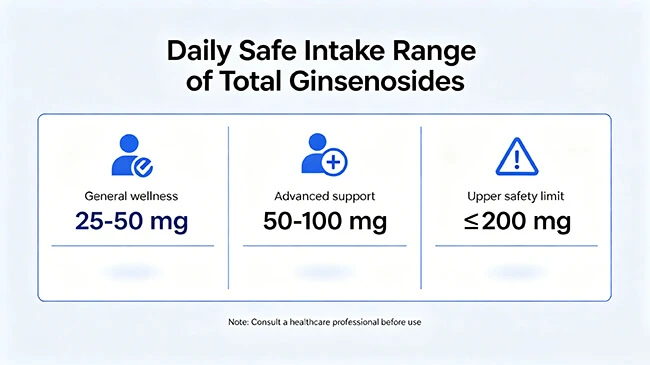
The basic wellness dosage of total ginsenosides ranges from 20 mg to 50 mg per day. This range is gentle, suitable for daily maintenance, and causes almost no side effects such as insomnia or irritability. For users looking for enhanced energy and stress relief effects, the moderate functional dosage can be set between 50 mg and 100 mg of total ginsenosides per day. The general upper safety limit for long-term daily use is 150 mg of total ginsenosides. Exceeding this dose for consecutive days may lead to restlessness, high blood pressure fluctuations or digestive discomfort, especially for sensitive groups. For people taking chronic medication, pregnant women, children and the elderly, the daily ginsenoside intake should be reduced to below 30 mg.
As a formulator or purchaser, you will work with ginseng extracts of different purity grades. I will sort out the matching ratios for mainstream specifications on the market to facilitate your formula design. Common commercial ginseng extracts are divided into three grades by total ginsenoside content: 10%, 20% and 30% total ginsenosides.
For a 10% ginseng extract (entry-level, cost-effective): To reach the basic wellness dose (20–50 mg ginsenosides), the daily addition of this extract is calculated at 200 mg to 500 mg. This grade is widely used in low-dose daily health products and compound herbal supplements.
For a 20% ginseng extract (mid-grade, balanced effect and cost): The daily extract dosage for standard wellness is 100 mg to 250 mg. It is the most popular specification for mainstream single-ingredient ginseng supplements due to stable efficacy and moderate price.
For a 30% high-purity ginseng extract (high-potency): Only 67 mg to 167 mg of the extract per day can meet the 20–50 mg ginsenoside requirement. This high-concentration extract is ideal for high-end functional supplements and targeted energy-support products, and it saves formula space for other active ingredients.
Different final dosage forms have different production processes and user taking habits, so the daily addition standards also vary. I have summarized practical reference values for the three most common formulations.
First, ginseng capsules, the most mainstream solid dosage form. A standard single capsule usually weighs 300 mg to 500 mg. For capsules using 20% ginseng extract, we suggest adding 150 mg to 250 mg of extract per capsule. Taking 1 capsule daily hits the ideal daily ginsenoside range for daily health. For high-potency capsules with 30% extract, 80 mg to 150 mg extract per capsule is sufficient, and one capsule per day is enough for long-term use.
Second, ginseng powder, often used in bulk wellness powders, meal replacements or instant drinks. For standalone ginseng powder, the recommended daily serving size is 200 mg to 400 mg when using 20% extract. It can be mixed with water, tea or beverages, and the dosage is easy to adjust for different consumer groups.
Third, oral liquid, a popular liquid formulation for easy absorption. A single serving of oral liquid is normally 10 mL to 30 mL. According to industry practices, add 80 mg to 200 mg of 20% ginseng extract per daily serving. Liquid products have faster dissolution, so we advise keeping the dosage at the lower end for long-term daily use to avoid excessive stimulation.
Many clients ask me: Why choose standardized ginseng extract instead of raw whole ginseng for daily supplement production? After comparing application effects and production performance, the advantages of extracts are very obvious.
Whole raw ginseng roots contain low and unstable ginsenoside content. A fixed weight of raw root cannot guarantee consistent active ingredients in each batch, which fails the strict content uniformity requirements of dietary supplements. Besides, raw ginseng has heavy fiber, slow human absorption, and a strong bitter taste, which greatly reduces consumer experience. In terms of storage and transportation, fresh or dried ginseng roots are prone to mildew, moisture and quality deterioration.
In contrast, standardized ginseng extracts undergo professional extraction, purification and concentration. The total ginsenoside content is fixed batch by batch, fully complying with supplement quality standards. The active ingredients have higher bioavailability, so the body can absorb and utilize them more efficiently during daily intake. Extracts are fine powder or concentrated liquid, with pure flavor, small volume, stable properties and long shelf life - perfectly adapted to large-scale industrial production of capsules, powders and oral liquids. For brand owners and manufacturers, extracts also bring lower packaging and logistics costs.

Based on years of experience in herbal extract production, our factory supplies full-series ginseng extracts with 10%, 20% and 30% total ginsenosides. All products are tested strictly, with complete COA, heavy metal test reports and microbial test reports to meet international supplement regulations. We support bulk wholesale, customized purity and custom formula cooperation. All regular specifications are in stock for fast delivery, which can effectively shorten your production cycle. Whether you need conventional low-purity extracts for mass products or high-purity concentrated extracts for high-end lines, we can provide stable and reliable raw material support.
To sum up, taking ginseng every day is healthy and safe as long as you control the total ginsenoside intake within the standard range. Choosing standardized ginseng extracts with clear active content is the key to producing safe, effective and compliant daily ginseng supplements. If you are looking for high-quality, stable ginseng raw materials for your next product line, feel free to get in touch for detailed specifications and wholesale solutions.

References
WebMD. Ginseng: Uses, Dosage, Side Effects, Interactions. https://www.webmd.com/vitamins/ai/ingredientmono-993/ginseng
Healthline. Ginseng: Benefits, Side Effects, Dosage, and Interactions. https://www.healthline.com/nutrition/ginseng-benefits
United States Pharmacopeia (USP). Herbal Monographs – Ginseng Extract Safety & Dosage Guidelines.
Mayo Clinic. Herbal Supplements: Safe Use of Ginseng for Daily Wellness. https://www.mayoclinic.org/healthy-lifestyle/consumer-health/in-depth/herbal-supplements/art-20047889