As consumer interest in cognitive optimization, stress resilience, and natural dopamine support continues to accelerate, Mucuna pruriens (velvet bean) has rapidly emerged as a flagship ingredient in premium nootropic and vitality formulations. However, as product developers, formulators, and brand owners, we face a critical challenge that casual consumers often overlook on public forums: the pharmacology of long-term daily ingestion and its corresponding safety constraints.
When an everyday consumer asks "Is it safe to take Mucuna pruriens daily?" on search engines, their underlying anxiety focuses heavily on dopamine crashes, receptor down-regulation, and habituation. For our brand partners, this consumer concern directly dictates labeling strategies, liability profiles, and customer retention. If a finishing product delivers erratic levels of the active alkaloid, L-Dopa (L-3,4-dihydroxyphenylalanine), the finishing brand risks causing either a lack of efficacy or severe receptor adaptation in their users.
In this guide, I will break down the toxicological frameworks of Mucuna pruriens, examine why raw botanical powders introduce unacceptable risk variables, and demonstrate how utilizing rigorously quantified, standardized extracts protects both your consumers' neurochemistry and your brand's market reputation.
The Pharmacological Core: Understanding Natural L-Dopa
Unlike standard adaptogenic herbs, Mucuna pruriens naturally synthesizes significant amounts of L-Dopa, the direct metabolic precursor to the neurotransmitter dopamine. When ingested, L-Dopa crosses the blood-brain barrier via the large neutral amino acid transporter (LAT1) system. Once inside the central nervous system, it undergoes rapid decarboxylation by the enzyme aromatic L-amino acid decarboxylase (AADC) to become active dopamine.
This pathway bypasses tyrosine hydroxylase, which is the natural rate-limiting step in endogenous dopamine synthesis. Because this regulatory checkpoint is bypassed, oral consumption of L-Dopa forces an increase in dopamine synthesis and subsequent release into the synaptic cleft. While this delivers immediate benefits for focus, drive, and motor control, chronic and unquantified daily stimulation poses clear physiological risks.
The Down-Regulation Risk Variant
Continuous, elevated concentrations of synaptic dopamine trigger homeostatic counter-measures in the brain. Post-synaptic dopamine receptors begin to down-regulate, reducing their surface density to maintain equilibrium. Concurrently, tyrosine hydroxylase activity is suppressed via negative feedback loops. If your formula delivers an unmeasured, high dose day after day, the consumer's endogenous dopamine machinery goes dormant, resulting in severe mood drops, lethargy, and tolerance development upon cessation.
The Structural Risk of Raw, Unstandardized Botanical Powders
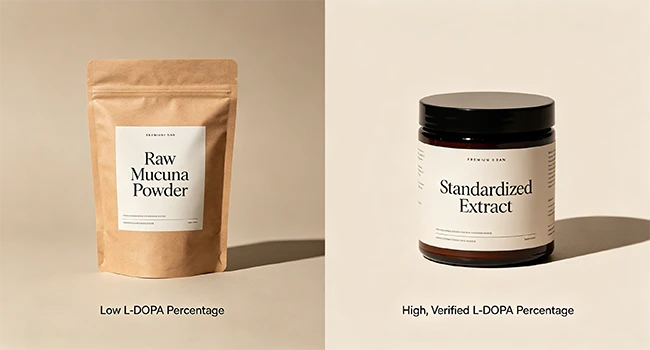
Many brands enter the market utilizing raw, milled Mucuna pruriens seed powder because of its lower initial material cost. From an analytical quality standpoint, however, this strategy introduces severe batch-to-batch volatility. The native concentrations of L-Dopa within raw wild-crafted seeds vary drastically based on environmental realities, including agricultural soil quality, annual rainfall, geographic altitude, and post-harvest drying protocols.
Peer-reviewed agronomic analyses demonstrate that native L-Dopa content in raw Mucuna pruriens seeds fluctuates wildly between 1.5% and 6.2% by dry weight. To visualize this from an R&D perspective, let us evaluate what happens when a brand attempts to formulate a daily capsule containing 1,000 mg of raw seed powder:
Batch Context
| Raw Material Input
| Native L-Dopa Yield
| Delivered L-Dopa Dose
| Consumer Impact & Safety Risk
|
Batch A (Low-yield crop)
| 1,000 mg
| 1.5%
| 15 mg
| Sub-therapeutic; poor product reviews, no consumer retention.
|
Batch B (Median standard)
| 1,000 mg}
| 3.5%
| 35mg
| Moderate efficacy; fits within target consumer baselines.
|
Batch C (High-yield crop)
| 1,000 mg
| 6.2%
| 62 mg
| Hyper-stimulation; potential for acute nausea, anxiety, and rapid receptor fatigue.
|
This massive variance means your consumers are playing a neurological guessing game. When a consumer asks if they can take the product daily, the answer for raw powder is an absolute "No," because a single high-yielding batch can trigger acute gastrointestinal upset, orthostatic hypotension, or rapid receptor desensitization.
The Standardization Solution: 15% and 20% HPLC Benchmarks
To establish a clean safety profile that permits structured daily use, product developers must transition away from whole-plant powders to concentrated, standardized extracts. Through precise aqueous-alcoholic extraction and purification, our manufacturing laboratories isolate and bind the active L-Dopa molecules to a predictable, fixed concentration-typically quantified at 15% or 20% via High-Performance Liquid Chromatography (HPLC) testing.
Standardization completely changes the consumer safety equation. When your R&D team designs a formulation using a 15% standardized extract, 100 mg of raw input guarantees precisely 15 mg of active, bioavailable L-Dopa across every production run, regardless of seasonal crop variations. This predictable delivery pattern allows your medical advisory boards to establish accurate, safe, and highly effective daily labeling thresholds.
Toxicological Limits and Safe Daily Target Dosing
In clinical medical evaluations, isolated synthetic L-Dopa is often administered at massive therapeutic thresholds (often exceeding 500mg to 1,000 mg daily) to manage profound motor dysfunction. At those massive clinical doses, side effects such as involuntary dyskinesia and psychiatric disturbances are common.
In the consumer supplement space, however, the target is sub-clinical optimization. Research indicates that safe, long-term daily supplementation should target an active L-Dopa window of 30mg to100mg per day. This target provides excellent support for focus, testosterone optimization, and stress management without overwhelming the synaptic cleft or forcing aggressive receptor downregulation.
By using a 15% or 20% extract, your engineering team can perfectly balance input math to hit this therapeutic window:
Using a 15% Extract: A raw material input of 333mg yields exactly 50mg of active L-Dopa.
Using a 20% Extract: A raw material input of 250mg yields exactly 50mg of active L-Dopa.
Co-Factors and Smart Labeling Architecture
To completely satisfy consumer safety queries and maximize the authority profile of your product line, the formula matrix itself should protect the user's nervous system. I highly recommend pairing your standardized Mucuna pruriens with balancing adaptogens and metabolic co-factors that optimize the dopamine cycle safely.
1. Peripheral Decarboxylase Inhibitors
If L-Dopa converts into dopamine in the bloodstream before passing the blood-brain barrier, it can cause peripheral side effects like mild nausea or cardiovascular adjustments. Pairing Mucuna with natural polyphenols, such as Green Tea Extract (standardized for EGCG), acts as a mild, safe peripheral decarboxylase inhibitor. This ensures the L-Dopa remains intact until it reaches its target destination in the brain, keeping peripheral side effects at zero.
2. Synergistic Adaptogens
Blending Mucuna with complementary adaptogens like Ashwagandha (Withania somnifera) helps stabilize cortisol pathways, tempering the stimulating nature of dopamine optimization and providing a smoother, non-jittery cognitive experience for daily users.
3. The Strategic "Cycle" Labeling Architecture
Even with strict standardization and ideal co-factors, human biology loves balance. To give your consumers absolute confidence and eliminate any risk of long-term habituation, your product label instructions should feature a transparent, proactive cycling strategy. Explicitly instructing users to adopt a "5 days on, 2 days off" weekly routine, or an "8 weeks on, 2 weeks off" seasonal macro-cycle, gives the brain's native receptors a structured window to reset, preventing any trace of down-regulation.
As an SEO specialist and technical advisor inside the botanical manufacturing pipeline, I cannot overstate this reality: your consumer safety answers are only as reliable as your ingredient supply chain. When sourcing a standardized Mucuna pruriens extract, your procurement team must look beyond basic price points and mandate exhaustive validation paperwork from your raw material manufacturer.
Every single batch of bulk extract must be backed by a comprehensive Certificate of Analysis (CoA) demonstrating verified HPLC testing for active L-Dopa levels. Furthermore, because Mucuna pruriens is a tropical legume, batches must undergo thorough testing for heavy metal metrics (Lead, Cadmium, Arsenic, and Mercury) and pesticide residues to meet strict regulatory compliance standards.
By building your formulation on verified, highly uniform standardized extracts, your brand transitions from a position of risk mitigation to market authority. You can directly answer the consumer's safety worries on your digital platforms with real data, empirical science, and bulletproof manufacturing transparency-protecting your consumer's health while scaling your market share.
References
Examine.com Monograph Database: Comprehensive clinical trial metadata regarding the bioavailability, human trial dosages, and safety profiles of Mucuna pruriens seed extracts.
National Center for Biotechnology Information (NCBI / PMC): Pharmacokinetic evaluations of natural L-Dopa absorption pathways, blood-brain barrier transport mechanics, and peripheral decarboxylation avoidance.
European Medicines Agency (EMA) & RIVM Risk Assessment Frameworks: Toxicological limits, receptor down-regulation metrics, and safety profiles for botanical substances containing pharmacologically active catechols.